News
Families + Gaming: The Connected Campfire
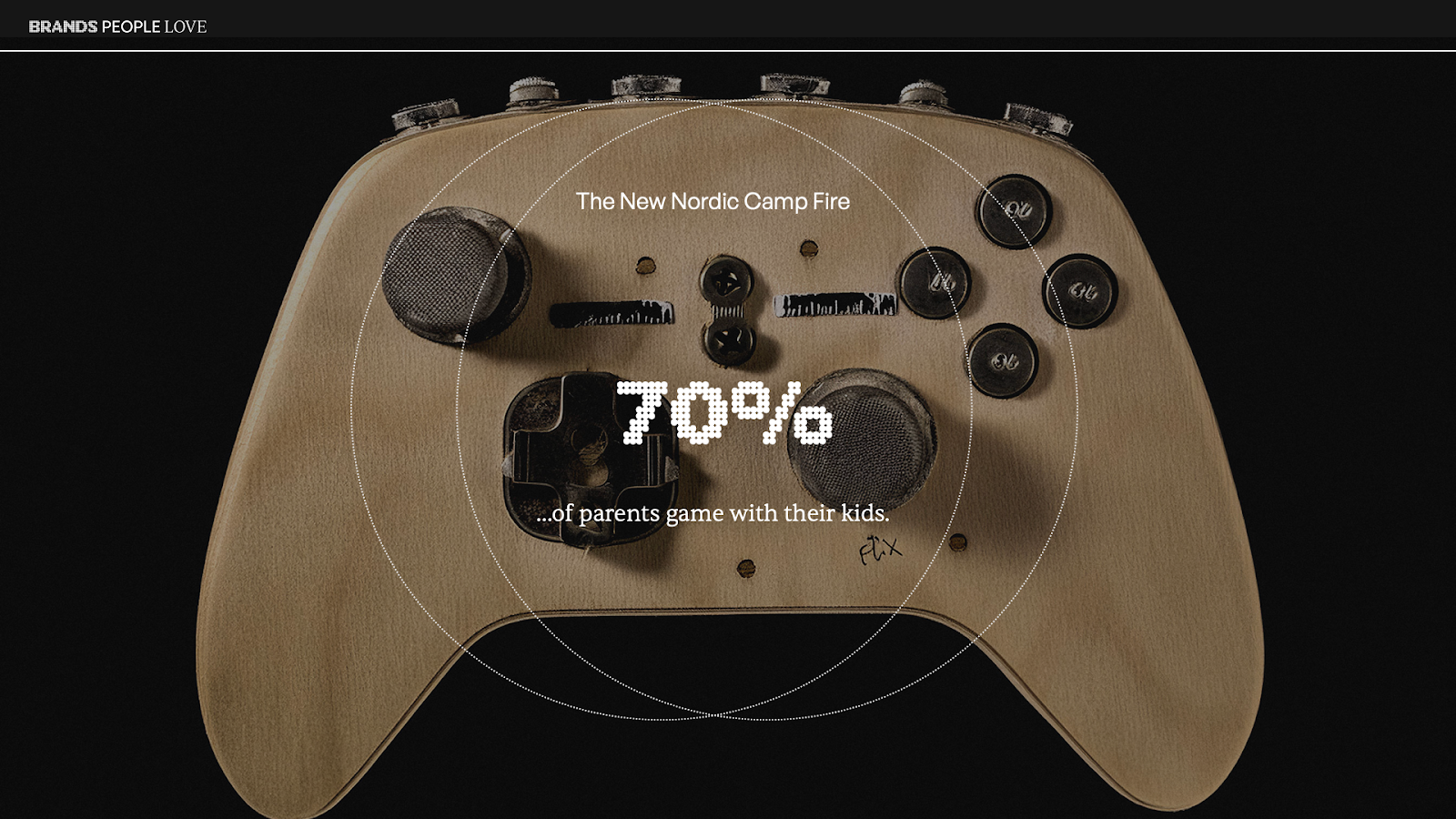
Families used to gather around the TV. Today, more of the culture children care about lives across games, YouTube, streaming and creator platforms — while the shared screen is becoming connected and interactive.
A connected campfire
Gaming is no longer a niche youth behaviour. It is part of mainstream culture, and for many families it is already something generations do together.
In a 2024 WildBrain/Savanta study across the US and UK, 65% of parents said they co-play video games with their children. Among the parents who already co-play, 63% named quality time as one of the main reasons.
Canadian research from ESAC/NPD found that 74% of gaming parents played video games with their children in 2022, up 9 percentage points over two years. In the same study, 69% said games helped them spend more time with their children.
The denominators matter: these studies do not mean that 74% of all parents play with their children, or that gaming automatically improves family relationships. What they do show is that shared digital play is already an established family behaviour.
From screen time to time together
The useful question is not whether all screen time is good or bad.
The American Academy of Pediatrics' 2026 framework treats digital media through both quantity and quality — including content, social context and interactivity. Shared media use can create opportunities for conversation, learning and adult support, while digital media can also interrupt connection depending on how it is used.
That is the territory FUN.G.I is interested in:
**What makes digital time become time together?**
The shared screen is changing
The living-room screen has not disappeared. What runs through it has changed.
Nordicom's Mediebarometern 2025 found that YouTube reached 52% of Swedes aged 9–85 on an average day, compared with 46% for scheduled television, while streamed TV reached 68%.
Nielsen's US co-viewing research reports that 47% of linear and connected-TV viewing happens with more than one person in front of the screen.
And YouTube reported in 2025 that more than one billion hours are watched on TV devices globally every day; in the US, TV had overtaken mobile as YouTube's primary device by watch time by December 2024.
The campfire has not disappeared. It has become connected.
What FUN.G.I does
**The small screen discovers. The big screen gathers.**
FUN.G.I takes content, culture and behaviours that often begin on personal screens and turns them into experiences families can watch, play and react to together.
Not more screen time for its own sake.
More quality time together. Not just next to each other.
What comes next
Through State of Family Play, FUN.G.I will build a recurring Swedish baseline for how families actually share their digital lives: co-viewing, co-play, co-creation, the move from personal screens to shared screens, parental presence in children's digital worlds and what families themselves call quality time.
Results will be published after the study has been conducted.
Sources
- Nordicom, Mediebarometern 2025
- Nielsen, co-viewing research 2024
- YouTube, living-room data 2025
- American Academy of Pediatrics, Digital Ecosystems 2026
- ESAC/NPD Canada 2022
- WildBrain/Savanta 2024
FUN.G.I is presented by Brands People Love and powered by Supertext.
More news
Supertext and Brands People Love in strategic partnership – building Sweden's new campfire for family entertainment
BPL announces a new family entertainment format – OLW cheez® first out